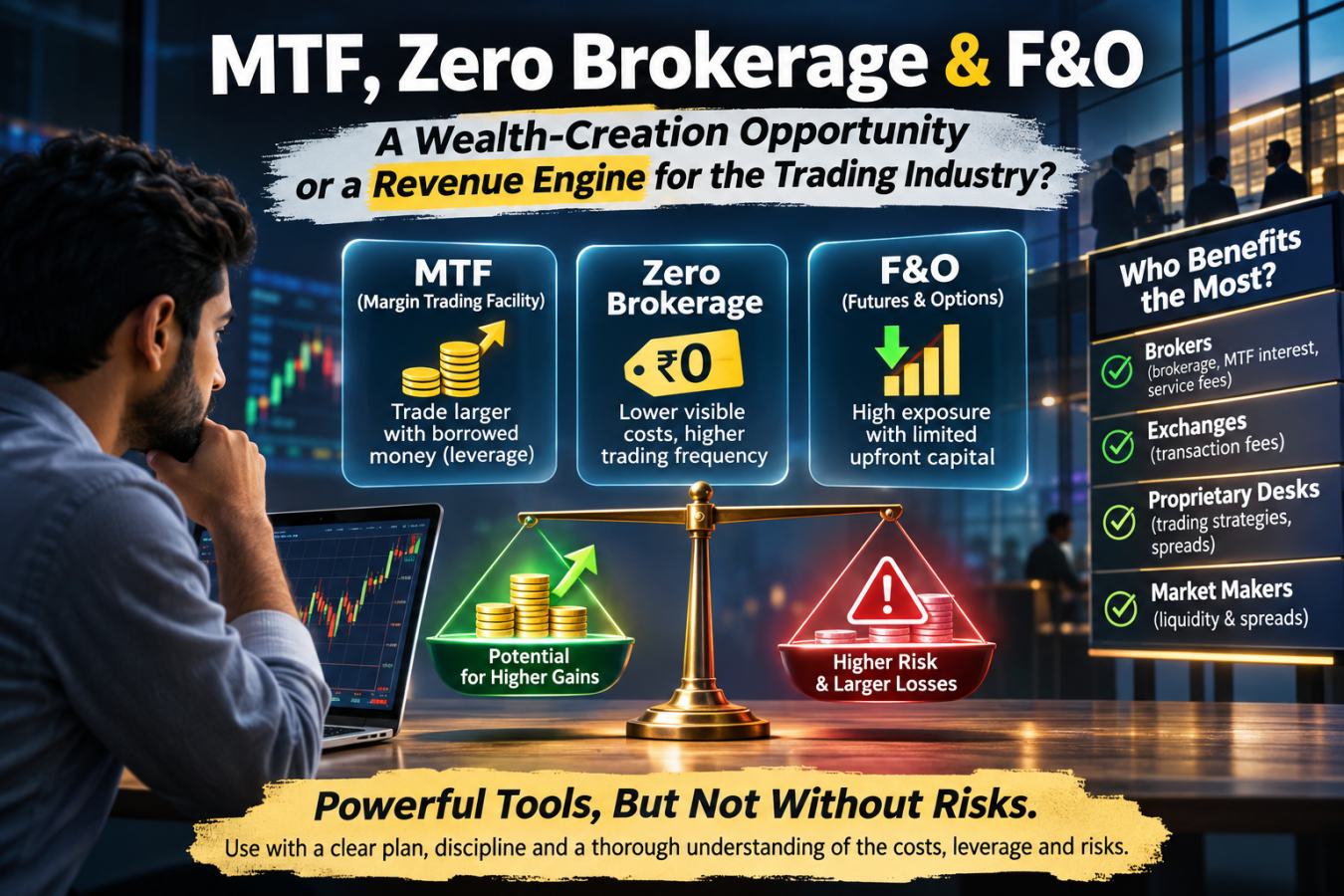
The biggest risk in modern stock markets may not be market volatility alone. It may be the business model that encourages investors to trade more, borrow more and take more risk.
Over the last decade, the Indian stock market has undergone a major transformation.
Demat accounts have increased, trading costs have declined, and sophisticated financial products are now accessible through mobile applications.
Three developments have played a particularly important role:
- Zero Brokerage: Making frequent trading appear inexpensive.
- Margin Trading Facility (MTF): Allowing investors to purchase more shares using borrowed funds.
- Futures & Options (F&O): Providing leveraged exposure to market movements with relatively small upfront capital.
These products are not inherently harmful. They serve legitimate purposes, including liquidity, hedging, capital efficiency and price discovery.
However, an important question deserves attention:
Are retail investors using these products to create wealth, or are some market participants benefiting from the trading activity they generate?
1. Zero Brokerage: When Trading Becomes Easy, Trading Frequency Can Increase
Earlier, brokerage costs were an important consideration before entering a trade.
Today, many platforms advertise zero brokerage on delivery trades or low flat fees on intraday and derivative transactions.
This reduces the visible cost of trading.
But zero brokerage does not mean zero trading cost.
Investors may still incur STT, exchange transaction charges, GST, stamp duty, regulatory charges and slippage. Brokers may also earn revenue through other permitted products and services.
The commercial incentive can be straightforward: a platform offering inexpensive transactions may benefit from higher customer activity, depending on its revenue model.
For investors, however, higher trading frequency does not automatically translate into higher profitability.
The danger begins when investors confuse low transaction costs with low investment risk.
2. MTF: Borrowing Money to Increase Market Exposure
Margin Trading Facility allows eligible investors to buy approved shares by paying part of the purchase value while the broker finances the balance.
Consider this hypothetical example:
MTF leverage: ₹5 lakh capital controlling ₹20 lakh exposure
Own capital: ₹5 lakh (25%)
Borrowed: ₹15 lakh (75%)
| Stock rises 10% | +₹2,00,000 |
| Stock falls 10% | −₹2,00,000 |
| Loss relative to own capital | 40% |
Illustrative 4× exposure, not a universal MTF margin. Excludes interest, charges and forced-liquidation effects.
A 10% decline in the underlying stock can eliminate 40% of the investor's initial capital in this example.
Meanwhile, the broker may earn financing interest while the loan remains outstanding, subject to its funding costs, credit risk and regulations.
This creates an important difference in economic exposure:
- The investor bears leveraged market risk.
- The broker earns financing income but also bears operational, credit and collateral risks.
- A sustained market decline may trigger margin calls or forced liquidation.
MTF can be useful for experienced traders with defined holding periods, risk controls and financing-cost awareness. It becomes dangerous when used to hold falling stocks indefinitely or average losing positions.
3. F&O: A Risk-Management Product That Can Become a Speculation Trap
Futures and options were developed to support hedging, risk transfer and price discovery.
But many retail participants use them for short-term speculation, especially through options buying.
Options can appear attractive because a relatively small premium provides exposure to a larger underlying value.
However, option buyers must contend with several factors beyond market direction, including time decay, implied volatility and the size and timing of price movements.
Even when a trader correctly predicts the broad direction, the option position can lose money.
SEBI's study of individual equity F&O traders for FY2022–FY2024 reported that approximately 93% of individual traders incurred losses over the three-year period.
That is a powerful reminder that access to leveraged instruments does not necessarily create a sustainable trading advantage.
4. Who Earns Money in the Trading Ecosystem?
| Participant | Potential revenue or advantage | Key risk |
| Stockbrokers | Brokerage, MTF interest, permitted service fees | Credit, compliance, operational and business risk |
| Exchanges | Transaction-related fees | Volume dependence and operational risk |
| Proprietary trading desks | Trading spreads, arbitrage and strategy profits | Market, liquidity and model risk |
| Market makers | Bid-ask spreads and risk-management opportunities | Inventory and adverse-selection risk |
| Retail traders | Trading profits when their strategy succeeds | Market losses, leverage, costs and behavioural mistakes |
It is important to distinguish a broker's transaction-related revenue from a proprietary desk's trading profits.
A proprietary desk is not guaranteed to make money whenever retail traders lose. Proprietary traders can also suffer substantial losses, and not every retail loss represents a corresponding profit for a broker or market maker.
Nevertheless, professional trading firms may possess advantages in technology, execution speed, research infrastructure, risk systems and transaction costs.
A retail investor competing in short-term markets should understand these differences.
5. The Real Conflict: Trading Activity Versus Investor Profitability
An investor's objective is usually to generate attractive risk-adjusted returns.
A trading platform's commercial objective may include increasing customer acquisition, financing balances, product adoption and transaction activity.
These objectives can overlap, but they are not identical.
A customer who trades 100 times may generate more transaction-related revenue than someone who trades five times, even if the frequent trader performs worse after costs.
This does not mean every broker encourages excessive trading. Many brokers also provide valuable education, risk warnings and controls.
But investors should be conscious of incentives whenever they are encouraged to trade more frequently or increase leverage.
6. What Retail Investors Should Do Differently
Retail investors should establish a clear distinction between investing, trading and speculation.
For long-term wealth creation, asset allocation, business fundamentals, valuation and holding discipline generally deserve greater attention than transaction frequency.
For active trading, investors should calculate the complete cost of each strategy, define maximum loss limits, avoid uncontrolled leverage and maintain records of net profitability after charges.
MTF should not become a substitute for adequate investment capital. F&O should not become a shortcut to earning regular income. And zero brokerage should never become a reason to execute unnecessary trades.
Final Thought
The Indian capital market has created tremendous opportunities for retail participation.
But financial accessibility and financial profitability are two different things.
The trading industry can earn revenue from activity. Investors earn sustainable wealth only when their decisions produce positive returns after costs and risks.
Before entering your next trade, ask yourself:
Am I taking this position because I have a genuine investment or trading opportunity, or simply because leverage and technology have made it easy?
The objective should not be to execute more trades.
The objective should be to make better decisions and preserve capital for opportunities that genuinely justify the risk.
Realexus Capital Advisors Pvt. Ltd. — Invest Wisely. Grow Consistently.
Disclaimer: Educational content only. The figures and scenarios are illustrative. Leveraged trading can result in substantial losses. Historical industry statistics do not predict individual outcomes.